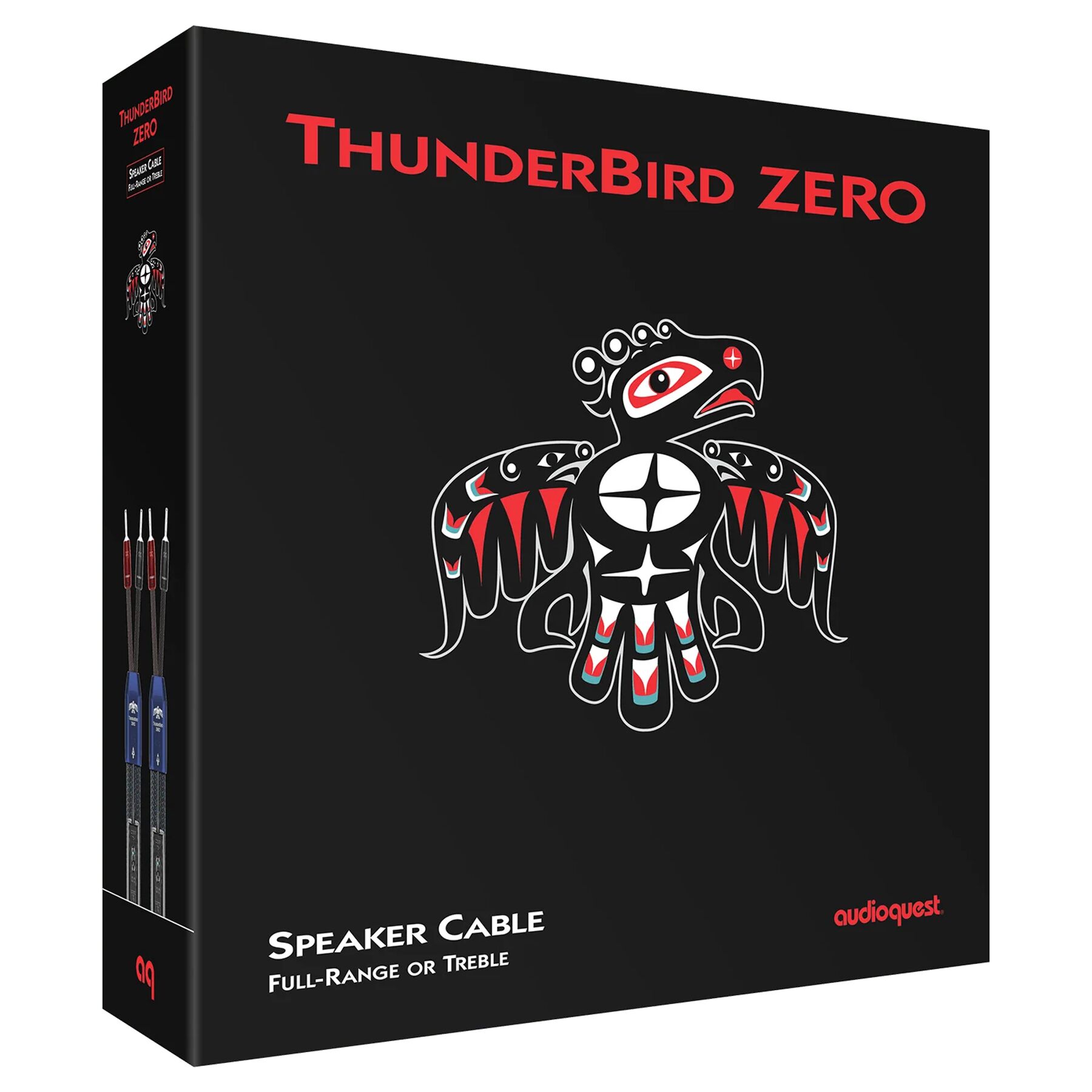
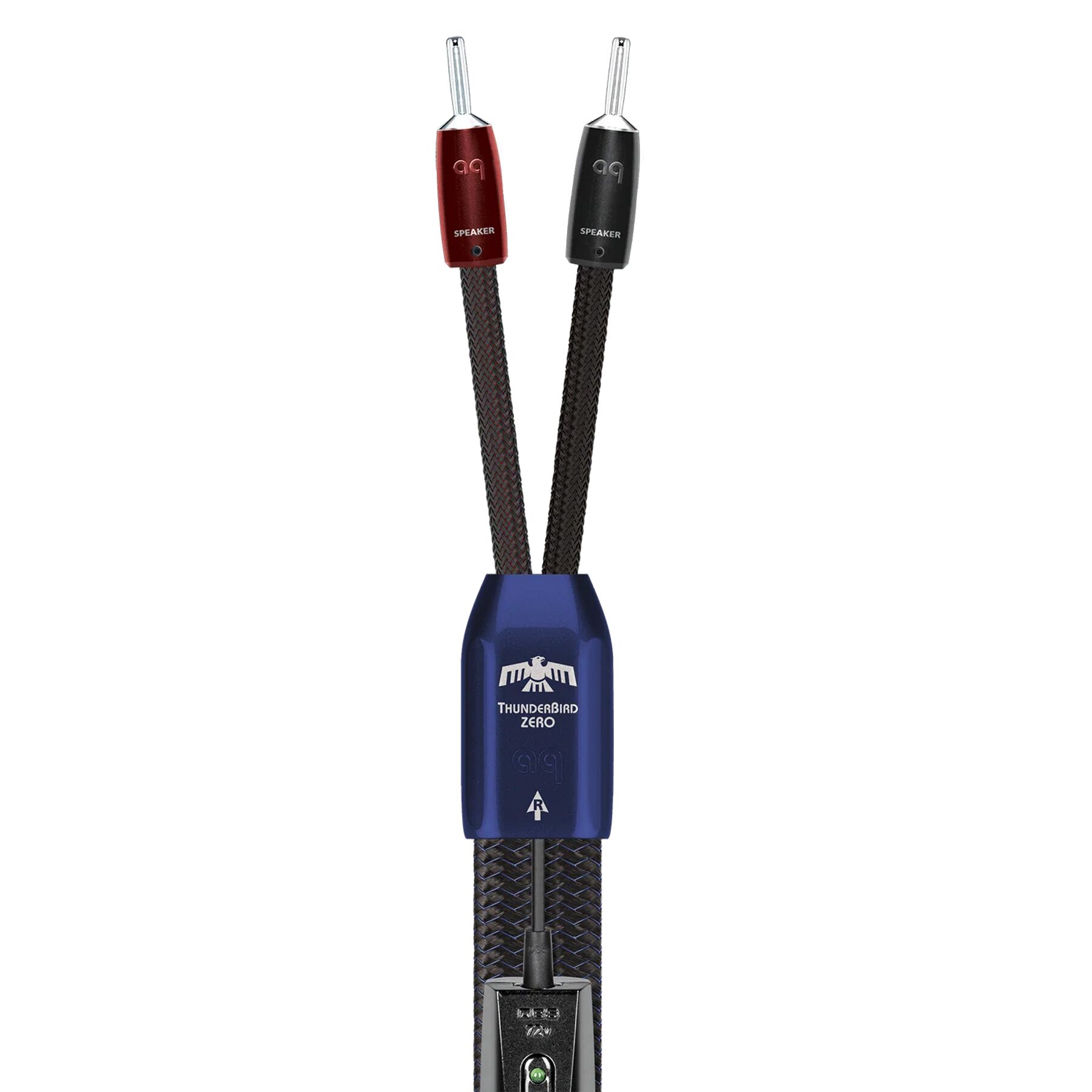
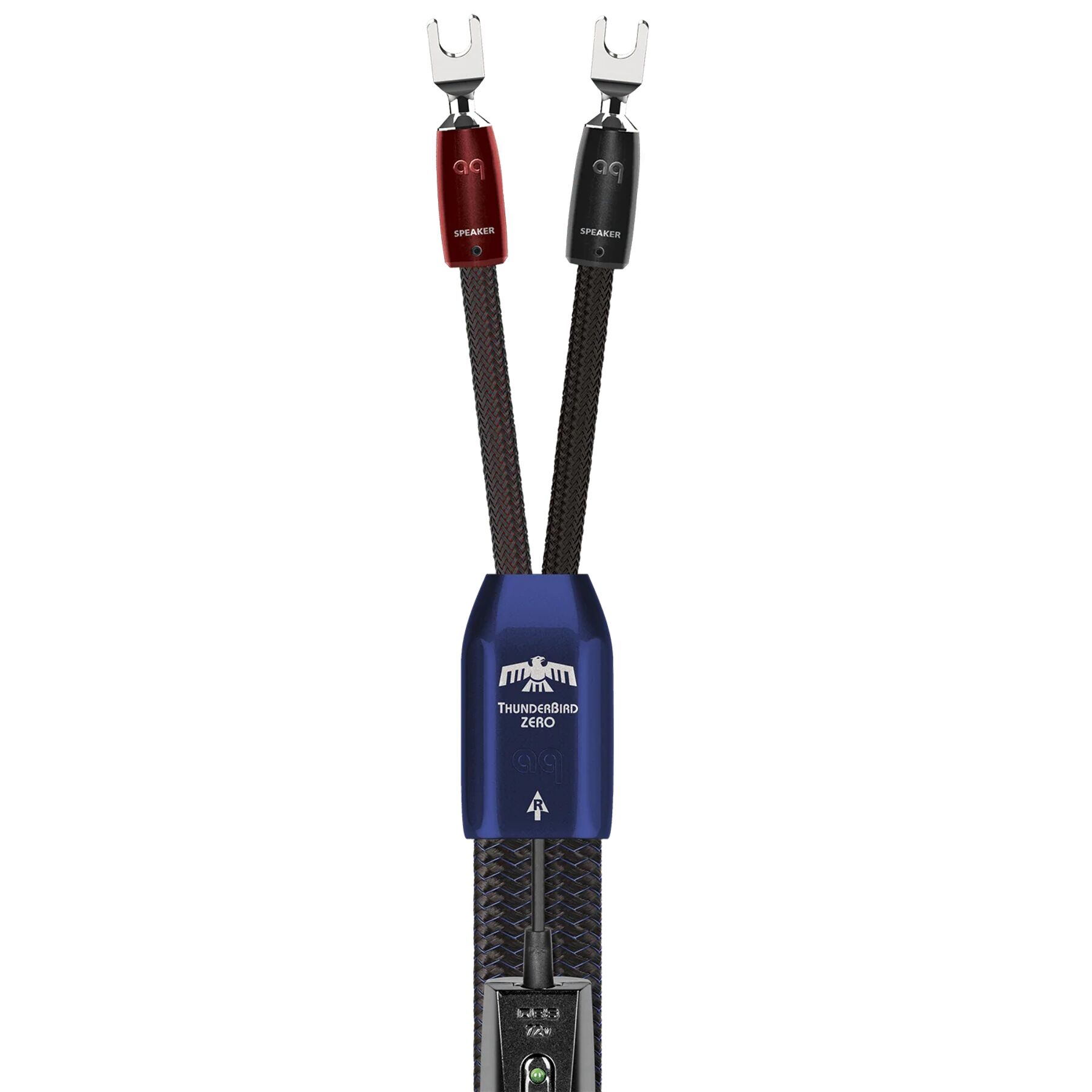
Thunderbird ZERO 3m
Thunderbird ZERO speaker cables may be used in one of two ways: either as ideal Full-Range cables, or, in combination with a dedicated BASS cable, in a BiWire cable assembly of unparalleled performance.
£5,800
1 Year warrantyFinance example
£1,160.00 initial 20% deposit then £193.33 per month for 24 months. Other finance terms available. Finance subject to statusThunderbird ZERO 3m
£5,800
Solid Perfect-Surface Copper+ (PSC+) Conductors
Solid conductors prevent strand-interaction, a major source of dynamic distortion. Extreme-purity PSC+ solid copper minimizes distortion caused by grain boundaries, and, when direction-controlled for surface asymmetry, facilitates crucial Radio-Frequency Noise-Dissipation.
Carbon-Based Linearized Noise-Dissipation System (NDS)
AQ’s comprehensive Linearized Noise-Dissipation System combines multiple shields and a carbon-based linearized resistive network that turns most of this noise into heat. By "linearized," we mean that the system is equally effective across extremely wide bandwidth, rather than at selected frequencies only, as is more common. The remaining bad energy is effectively drained away from the sensitive amplifier circuits via directionally controlled signal and shield conductors.
ZERO-Tech
The only complete way to eliminate characteristic-impedance mismatches between a cable and the attached source and load is for the cable not to have any fixed characteristic-impedance value. ZERO-Tech accomplishes this by eliminating interaction between the insulation (dielectric) and the cable’s conductors—enabling uncompressed current transfer. All-important transient current is unrestricted, and RF Noise-Dissipation is linearized (consistent octave to octave).
72v Dielectric-Bias System (DBS) with Level-X RF Noise-Trap
Insulation is also a dielectric that acts like a shunt-filter. Properly biasing the dielectric linearizes the filter, significantly improving the cable’s wide-bandwidth ability to dissipate induced noise. The DBS pack’s Level-X Noise-Trap “pulls” RF Noise out of the cable, further reducing attached audio circuit misbehavior.
Mythical Creature Cold-Welded Terminations
Mythical
Creature cables are Cold-Welded to AudioQuest’s extremely pure Red
Copper Spades or Bananas. The bare copper is submerged (hung) in a vat
of pure silver instead of being tumbled in a lower-grade solution.
AudioQuest speaker breakouts and plug casings are not metal in order not
to induce RF Noise into the conductors.
ThunderBird Bi-Wiring
When possible, running
separate cables to the treble and bass “halves” of a speaker
significantly reduces distortion. Bi-Wiring keeps the large magnetic
fields associated with bass energy out of the treble cable, allowing the
delicate upper frequencies to travel a less magnetically disturbed
path, like taking the waves out of the water when you swim.
AudioQuest’s RF/ND-Tech (patented RF-Canceling Ground-Noise-Dissipation) attracts RF energy away from the amplifier’s output. When properly implemented, Bi-Wiring has always been a cost-effective way to get better performance for the same or less money. With RF/ND-Tech, the advantage of Bi-Wiring is much more dramatic. Because RF/ND-Tech is so effective, BASS model cables are only for 10KHz and below; do not use a BASS cable full-range or on treble.
ThunderBird BASS cable is ideal with ThunderBird ZERO. A Bi-Wire COMBO with BASS and ZERO cables joined together at the amplifier is usually most convenient. When Tri-Wiring, use BASS cables on the Midrange and Bass inputs.
Caution: Do not Bi-Wire with two ZERO cables. ZERO cables in-parallel can create a very high-frequency resonant peak (ringing), and resulting poor sound. Only use a ZERO plus a BASS cable (whether or not joined as a COMBO). Second best is a single ZERO with AQ Bi-Wire jumpers.
Available in 2-4M pairs. Please call for pricing.
Tech spec
Metal
Solid Perfect-Surface Silver (PSS) Sonic-Signature Conductors & Perfect-Surface Copper+ (PSC+)
Gauge
5.26mm²
Geometry
ZERO-Tech (No Characteristic Impedance)
Jacket
Black on Black Nylon Braid
Noise-Dissipation
RF/ND-Tech and Multi-Layer Carbon-Based Noise-Dissipation

POPULAR CATEGORIES